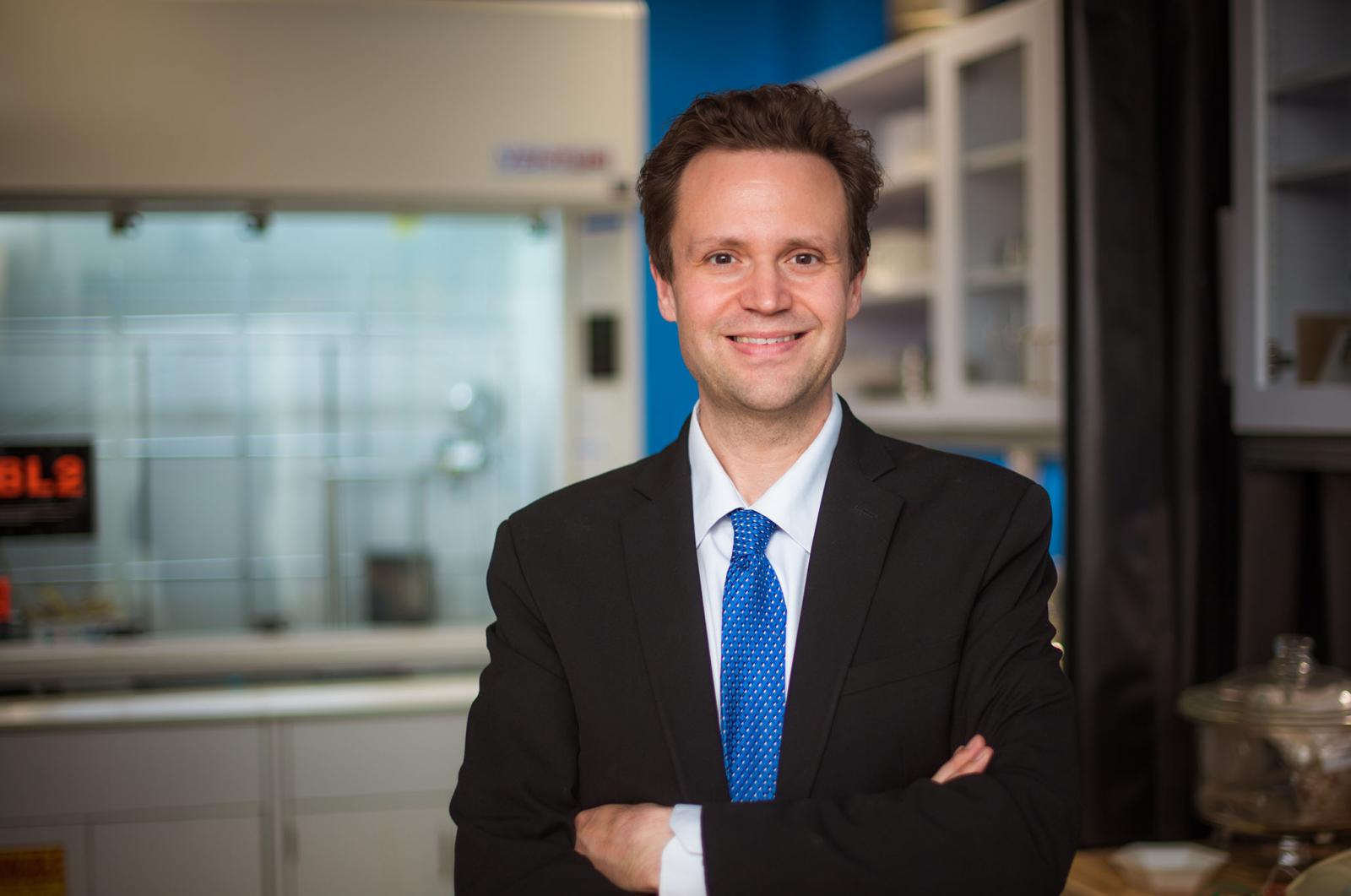
McAfee Professor of Engineering
Markus Buehler
Jerry Mcafee (1940) Professor in Engineering
Interests
- Atomistic, molecular and multiscale modeling
- Artificial intelligence and machine learning
- Bioinspired design, biomaterials and protein materials, additive manufacturing
Professor Buehler News + Media
New AI tool calculates materials’ stress and strain based on photos
The advance could accelerate engineers’ design process by eliminating the need to solve complex equations.
Worm-inspired material strengthens, changes shape in response to its environment
A bio-inspired gel material developed at MIT could help engineers control movements of soft robots.
Conch shells spill the secret to their toughness
Three-tiered structure of these impact-resistant shells could inspire better helmets, body armor.
Faculty Details
Education
-
2004
Max Planck Institute for Intelligent Systems & University of Stuttgart
PhD, Materials Science/Chemistry -
2001
Michigan Technological University
M.S., Engineering Mechanics -
2000
University of Stuttgart
B.S. eq., Process and Chemical Engineering
Research Interests
- Deformation and failure
- Protein folding and property prediction
- Biomass conversion
- Multiscale modeling
- Artificial intelligence, machine learning
- Additive manufacturing
- Hierarchical materials
- Bio-inspired materials (analysis, design, manufacturing)
- Fracture mechanics
- Solid mechanics
- Deformation and failure
- Rare events
- Molecular modeling methods
- Biophysics
- Category theory
- Deep learning
Bio
EXECUTIVE SUMMARY
Markus J. Buehler is the McAfee Professor of Engineering at MIT (an Institute-wide Endowed Chair), a member of the Center for Materials Science and Engineering, and the Center for Computational Science and Engineering at the Schwarzman College of Computing. He holds academic appointments in Mechanical Engineering and Civil and Environmental Engineering. In his research, Professor Buehler pursues new modeling, design and manufacturing approaches for advanced biomaterials that offer greater resilience and a wide range of controllable properties from the nano- to the macroscale. His interests include a variety of functional material properties including mechanical, optical and biological, linking chemical features, hierarchical and multiscale structures, to performance in the context of physiological, pathological and other extreme conditions. His methods include molecular and multiscale modeling, design, as well as experimental synthesis and characterization. His particular interest lies in the mechanics of complex hierarchical materials with features across scales (e.g. nanotubes, graphene and natural biomaterial nanostructures including protein materials such as intermediate filaments and hair, collagen, silk and elastin, and other structural biomaterials). An expert in computational materials science and AI, he has pioneered the field of materiomics, and demonstrated broad impacts in the study of mechanical properties of complex materials, including predictive materials design and manufacturing. Between 2013-2020, Buehler served as Department Head of MIT’s Civil and Environmental Engineering Department. He has held numerous other leadership roles at professional organizations, including a term as President of the Society of Engineering Science (SES).
ADDITIONAL BACKGROUND
Prof. Buehler has authored more than 500 peer-reviewed publications (H-index=116), which have been cited more than 49,000 times, and authored two monographs (as well as several edited books). He has given more than 500 invited/keynote/plenary talks around the world, and given several highly-praised TED talks. His technical innovations have resulted in several patents. Buehler’s recent research has resulted in a new paradigm for the analysis of bio-inspired materials and structures to devise new biomaterial platforms, and using a mathematical categorization approach that connects insights from disparate fields such as materials, structures to music and language. His work also includes the introduction of AI methods in materials modeling and design, especially fracture mechanics, featuring a novel perspective to connect datasets form experiment and simulation to develop multiscale models. He has applied these methods to wide ranging areas of application including protein folding, fracture, and composite design, and coupled the de novo design methods with additive manufacturing approaches. He is well-known for his research on mechanically relevant proteins, especially silk, elastin, intermediate filaments, and collagen.
He is the Editor in Chief of the Journal of the Mechanical Behavior of Biomedical Materials (since his inaugural appointment, the impact factor increased from 2.876 to 4.042). He was recently elected as the inaugural Section Editor of MRS Bulletin Impact by the Materials Research Society, and is active on the editorial board of many other top-ranked peer-reviewed journals, such as APL Machine Learning, Extreme Mechanics Letters, Biophysical Journal, and Computational Materials Science.
Buehler has served in numerous leadership roles, including as an elected member of the Board of Directors of the Society of Engineering Science (SES) (2016-2018) and between 2018 and 2020 served as President-elect, President and Past President of the SES. He served as the chair of several conferences (including the ASME Global Congress on NanoEngineering for Medicine and Biology meeting in 2013, several times as Chair/Co-Chair of the International Conference on Mechanics of Biomaterials & Tissues). He served as the inaugural chair of the ASCE Biomechanics Committee and on the Executive Committee of the ASME Materials Division (2015-2018). In addition to various other committees in professional organizations, Buehler is actively involved in public outreach. He offers an annual mechanics and materials research camp at MIT with local middle and high schools, funded by the U.S. Army Educational Outreach Program (AEOP) and UNITE program. The program featured 46 students in 2022, with a 45% female and/or URM participation. He served as MRS Fall 2021 Meeting Chair, one of the largest materials research conferences and has organized many other workshops and symposia.
Buehler is an accomplished academic leader and administrator. Between 2013-2020, Buehler served as Department Head of MIT’s Civil and Environmental Engineering Department. His leadership resulted in an increase in rankings (US News & World ranking increased from 8 to 3; ranking in QS World University Rankings consistently 1), the development of a new undergraduate curriculum, extensive space renovations and fundraising. Buehler led a faculty hiring campaign and renewed around 1/3 of the department faculty resulting in 12 new faculty hires (7 women and 2 URM faculty; overall 58% female/URM). At the end of his tenure CEE had the second highest ratio of female faculty in the MIT School of Engineering. During his tenure, Buehler appointed the first female and the first African American Associate Department Head. To identify, promote and recruit female star researchers pursuing faculty-track careers, he introduced the Rising Stars program.
He is the recipient of many awards including the ASME Drucker Medal, the Feynman Prize, the IACM Fellows Award, the J.R. Rice Medal, the Harold E. Edgerton Faculty Achievement Award, the Alfred Noble Prize, the Leonardo da Vinci Award, and the Thomas J.R. Hughes Young Investigator Award, and many others. He further received numerous government agency recognitions, including the National Science Foundation CAREER award, the United States Air Force Young Investigator Award, the Navy Young Investigator Award, the Defense Advanced Research Projects Agency (DARPA) Young Faculty Award, as well as the Presidential Early Career Award for Scientists and Engineers (PECASE). He has been selected as a Clarivate Highly Cited Researcher. In 2020, he was named as one of the global top 0.09% of all researchers worldwide in the nanoscience category in a study from Stanford University.
In addition to his teaching at MIT, he offers two annual Professional Education courses on “Predictive Multiscale Materials Design” and “Machine Learning for Materials Informatics”. These courses have been taken by more than 150 engineering, scientific and other professionals. Based on his record in the translation of basic research into practice through entrepreneurship, Buehler is involved with startups and innovation, such as through his role on the Board of Directors of Sweetwater Energy, Inc. and as a member of the Scientific Advisor Board of Safar Partners (A Technology Venture Fund). He has experience in scientific and engineering consulting for industry, government agencies, and as expert witness for a variety of technologies, in particular materials science and mechanical properties, including fracture. In his work at MIT he has collaborated with numerous corporate partners, including BASF (development of novel additives for road pavements), Teledyne (development of thermal/mechanical heat dissipation strategies using nanotubes), Henkel (development of adhesive designs), and Ferrovial/Cadagua (development of technologies to translate organic waste to structural materials).
As a composer of classical and experimental music with a special interest in science-based sonification, he is active in scientific outreach and the intersection of art and science, and a member of the Executive Committee of MIT’s Center for Art, Science and Technology (CAST). His work has resulted in contributions to exhibitions and performances at international art venues (e.g. Palais de Tokyo, Guggenheim/e-flux, Harvard Arts First Festival). In 2022, his work was also incorporated into the collection of the Library of Congress, Music Division.
Buehler is a member of the National Academy of Engineering.
Honors + Awards
- Washington Award, 2025
- Member, National Academy of Engineering, 2023
- Society of Engineering Science (SES) James R. Rice Medal, 2022
- International Association for Computational Mechanics (IACM) Fellows Award, 2022
- ASME Drucker Medal, 2021
- Royal Society of Chemistry Materials Horizons Outstanding Paper Prize, 2019
- MIT Distinguished Service and Leadership Award, 2021
- Clarivate Analytics Highly Cited Researcher Award, 2018 (recognized for exceptional research performance demonstrated by production of multiple highly cited papers that rank in the top 1% by citations for field and year in Web of Science)
- Feynman Prize (Foresight Institute), Theory, 2016
- Outstanding Young Scientist Award, NANOSMAT Society, 2016
- Fellow, NANOSMAT Society, 2016
- International Journal of Applied Mechanics (IJAM) Most Cited Paper Award (2009-2015), 2016
- Fellow, American Institute for Medical and Biological Engineering (AIMBE), 2015
- ASME Journal of Applied Mechanics Award 2014 (with student Zhao Qin)
- The Minerals, Metals & Materials Society (TMS) Robert Lansing Hardy Award, 2013
- NAE Frontiers of Engineering: Plenary Speaker, 2008 and 2013; Invited Participant, 2007
- TMS Structural Materials Division Best Paper Award 2013
- Materials Research Society (MRS) Outstanding Young Investigator Award, 2012
- IEEE Holm Conference Morton Antler Lecture Award, 2012
- SES Young Investigator Medal, 2012
- Alfred Noble Prize, 2011
- ASME Thomas J.R. Hughes Young Investigator Award, 2011
- ASCE Leonardo Da Vinci Award, 2011
- Stephen Brunauer Award, 2011 (American Ceramic Society)
- AIME Rossiter W. Raymond Memorial Award, 2011
- ASME Sia Nemat Nasser Award, 2010
- MIT Harold E. Edgerton Faculty Achievement Award, 2010
- Presidential Early Career Award for Scientists and Engineers (PECASE), 2009 (the award was presented by President Barack Obama at the White House)
- United States Navy Young Investigator Award, 2008
- DARPA Young Faculty Award, 2008
- Air Force Office of Scientific Research Young Investigator Award, 2008
- National Science Foundation CAREER Award, 2007
- Materials Research Society Gold Graduate Student Award, 2004
Memberships
- ASME
- Society of Engineering Science
- Materials Research Society
- American Institute for Medical and Biological Engineering
Professional Service
Editorial Activities:
Editor-in-Chief, J. Mech. Behav. Biomed. Mat. (Elsevier); Section Editor, MRS Bulletin Impact; Editor-in- Chief, BioNanoScience (Springer); Cell Matter, Member of the Editorial Advisory Board (Cell Press); Editorial Advisory Board, ACS Biomaterials Science and Engineering (American Chemical Society); Proceedings of the National Academy of Sciences (PNAS), Handling Editor; Editorial Board Member, Extreme Mechanics Letters (Elsevier); Editor Board Member, Scientific Reports (Nature Publishing Group); Editorial Board, Computational Materials Science (Elsevier); Academic Editor, PLoS ONE (Public Library of Science); Associate Editorial Board, Frontiers in Mechanics of Materials (Frontiers); Guest Editor, MRS Bulletin (MRS); Executive Editor, International Journal of Applied Mechanics (Imperial College Press); Associate Editor, Journal of Engineering Mechanics (ASCE); Editorial Board, Journal of Nanomechanics and Micromechanics (ASCE); Associate Editor, J. Comp. Theor. Nanosci. (Amer. Sci. Publ.); Editor, Acta Mech. Sinica (Springer Nature); Guest Editor of J. Mater. Res. (Springer Nature).
Committees and Service (selection):
MIT Committee on Arts, Culture, and DEI, 2021-2022; Chair, MRS Fall 2021 Meeting, 2019-2021; Member, Core Committee of New Engineering Education Transformation (NEET), MIT, 2017-2019; MIT Refugee ACTion (ReACT) Senior Advisory Committee, 2017- now; MIT Center for Computational Engineering Advisory Council, 2019-now; 2018-19, Co-Chair Eighth International Conference on Mechanics of Biomaterials & Tissues; Member of the Executive Committee, ASME Materials Division (2015-2018); Co-Chair, NanoEngineering in Medicine and Biology (NEMB) Congress 2013, Boston, 2013; Chair, Fourth International Conference on Mechanics of Biomaterials & Tissues 2011, Hawai’i; Inaugural Chair, Biomechanics Committee at the ASCE Engineering Mechanics Institute (EMI), 2008-2014; Co-Chair, NanoEngineering for Medicine & Biology Congress Steering Committee of ASME, 2010-2013; Member, ASME Nanoengineering Council Executive Committee, 2010.
Teaching
- 3.021J Introduction to Modeling and Simulation
- 1.050 Engineering Mechanics (undergraduate)
- 1.545 Atomistic Modeling and Simulation of Materials and Structures
- 1.052/1.121/ 2.169 Advancing Mechanics and Materials via Machine Learning (first offered Spring 2023)
- Professional Education: Predictive Multiscale Materials Design
- Professional Education: Machine Learning for Materials Informatics
- Co-instructor, “Machine Learning, Modeling, and Simulation: Engineering Problem-Solving in the Age of AI,” MIT Professional & Executive Learning
Publications
Full list: https://scholar.google.com/citations?user=hWBTSksAAAAJ&hl=en
Selected publications
- B. Ni, M.J. Buehler, MechAgents: Large language model multi-agent collaborations can solve mechanics problems, generate new data, and integrate knowledge, Extreme Mechanics Letters, Vol. 67, 102131, 2024.
- M.J. Buehler, Cephalo: Multi-Modal Vision-Language Models for Bio-Inspired Materials Analysis and Design, arXiv https://arxiv.org/abs/2405.19076, 2024.
- M.J. Buehler, Accelerating Scientific Discovery with Generative Knowledge Extraction, Graph-Based Representation, and Multimodal Intelligent Graph Reasoning, arXiv https://arxiv.org/abs/2403.11996, 2024.
- S.C. Shen, N.A. Lee, W.J. Lockett, A.D. Acuil, H.B. Gazdus, B.N. Spitzer, M.J. Buehler, Robust myco-composites: a biocomposite platform for versatile hybrid-living materials, Mat. Horiz., 11, 1689-1703, 2024.
- M.J. Buehler, MechGPT, a Language-Based Strategy for Mechanics and Materials Modeling That Connects Knowledge Across Scales, Disciplines, and Modalities, ASME Appl. Mech. Rev., 76(2): 021001, https://doi.org/10.1115/1.4063843, 2024.
- E.L. Buehler, M.J. Buehler, X-LoRA: Mixture of Low-Rank Adapter Experts, a Flexible Framework for Large Language Models with Applications in Protein Mechanics and Design, APL Mach. Learn. 2, 026119, https://doi.org/10.1063/5.0203126, 2024.
- A. Lew, M.J. Buehler, “Single-shot forward and inverse hierarchical architected materials design for nonlinear mechanical properties using an attention-diffusion model,” Mater. Tod., 2023, 10.1016/j.mattod.2023.03.007, 2023.
- M. Buehler, “Unsupervised cross-domain translation via deep learning and adversarial attention neural networks and application to music-inspired protein designs,” Patterns, 2023, 10.1016/j.patter.2023.100692.
- R. Luu and M.J. Buehler, BioinspiredLLM: Conversational Large Language Model for the Mechanics of Biological and Bio‐Inspired Materials, Adv. Sci., https://doi.org/10.1002/advs.202306724, 2023
- F. Liu, B. Ni, M.J. Buehler, “PRESTO: Rapid protein mechanical strength prediction with an end-to-end deep learning model,” Extreme Mechanics Letters, paper # 101803, 2022
- Z. Yang, M.J. Buehler, “High‐Throughput Generation of 3D Graphene Metamaterials and Property Quantification Using Machine Learning,” Small Methods, paper # 2200537, 2022
- A.J. Lew, M.J. Buehler, “DeepBuckle: Extracting physical behavior directly from empirical observation for a material agnostic approach to analyze and predict buckling,” JMPS, Vol. 164, 103909, 2022
- Z. Yang, C.-H. Yu, M.J. Buehler, “Deep Learning Model to Predict Complex Stress and Strain Fields in Hierarchical Composites,” Science Advances, DOI: 10.1126/sciadv.abd7416 , 2021
- E. Khare, N. Holten-Andersen, M.J. Buehler, “Transition metal-coordinate bonds in protein-inspired materials and engineered polymer hydrogels for tunable mechanical properties,” Nature Reviews Materials, DOI: 10.1038/s41578-020-00270-z, 2021
- K. Guo, M.J. Buehler, “A semi-supervised approach to architected materials design using graph neural networks,” Extreme Mechanics Letters, Vol. 41, pp. 101029, 2020
- M.J. Buehler, “Liquified protein vibrations, classification and cross-paradigm de novo image generation using deep neural networks,” Nano Futures, p. 035004, Vol. 4(3), 2020
- T. Sapra, Z Qin, A. Dubrokvsky-Gaupp, U. Aebi, D. Muller, M.J. Buehler, O. Medala, “Nonlinear mechanics of lamin filaments and the meshwork topology build an emergent nuclear lamina,” Nature Communications, DOI: https://doi.org/10.1101/846550, 2020
- M. Hsu, C.H. Yu, M.J. Buehler, “Using Deep Learning to Predict Fracture Patterns in Crystalline Solids,” Cell Matter, Vol. 3, 1-15, 2020
- C.H. Yu; M.J. Buehler, “Sonification based de novo protein design using artificial intelligence, structure prediction, and analysis using molecular modeling,” APL Bioengineering, Vol. 4(1), p. 016108, 2020.
- I. Su, M.J. Buehler, "Mesomechanics of a Three-Dimensional Spider Web," Journal of the Mechanics and Physics of Solids, Vol. 144, p. 104096, 2020
- D. Liu, A. Tarakanova, C. C. Hsu, M. Yu, S. Zheng, L. Yu, J. Liu, Y. He, D. J. Dunstan, and M. J. Buehler, “Spider dragline silk as torsional actuator driven by humidity,” Science Adv., Vol. 5, no. 3, 2019
- E. Beniash, C. Stifler, C.-Y. Sun, G.S. Jung, Z. Qin, M.J. Buehler, P. Gilbert, “The hidden structure of human enamel,” Nature Communications, paper #: 4383, 2019
- J. Yeo; G. Jung; F. Martin-Martinez; J. Beem; Z. Qin; M. Buehler, “Multiscale design of graphyne-based materials for high-performance separation membranes,” Advanced Materials, https://doi.org/10.1002/adma.201805665, 2019
- W. S. Leong, H. Wang, J. Yeo, F. J. Martin-Martinez, A. Zubair, P.-C. Shen, Y. Mao, T. Palacios, M. J. Buehler, J.-Y. Hong, and J. Kong, “Paraffin-enabled graphene transfer,” Nat. Commun., Vol. 10, p. 867, 2019.
- G.X. Gu, C.-T. Chen, M.J. Buehler "De novo composite design based on machine learning algorithm", Extreme Mechanics Letters 18, p. 19-28, 2018
- Y. Han, M. Li, G. Jung, M. A. Marsalis, Z. Qin, M. J. Buehler, L. Li, D. A. Muller "Sub-nanometre channels embedded in two-dimensional materials" Nature Materials (cover article), Vol. 17.2, pp. 129-133, 2018
- G. X. Gu, C.-T. Chen, D. J. Richmond, and M. J. Buehler, “Bioinspired hierarchical composite design using machine learning: simulation, additive manufacturing, and experiment,” Mater. Horizons, vol. 5, no. 5, pp. 939–945, 2018
- S. Ling; Z. Qin; W. Huang; S. Cao; D. L. Kaplan; M. J. Buehler, "Design and function of biomimetic multilayer water purification membranes," Science Adv., DOI: 10.1126/sciadv.1601939, 3 (4), e1601939, 2017 (the technology to develop filtration devices from silk, protein and hybrid nanofibrillar materials has been covered in a series of patents)
- Z. Qin, G.S. Jung, M.J. Kang, M.J. Buehler, “The mechanics and design of a lightweight three-dimensional graphene assembly,” Science Advances 3 (1), e1601536SD, 2017
- S.J. Ling; C.M. Li; K. Jin; D.L. Kaplan; M.J. Buehler, "Liquid Exfoliated Natural Silk Nanofibrils: Applications in Optical and Electrical Devices," Advanced Materials, 28 (35), pp. 7783, 2016
- C.C. Chou, M.J. Buehler, Structure and Mechanical Properties of Human Trichocyte Keratin Intermediate Filament Protein, Biomacromolecules, Vol. 13(11), 3522-3532, 2012
- S.W. Cranford, A. Tarakanova, N. Pugno, M.J. Buehler, “Nonlinear constitutive behaviour of spider silk minimizes damage and begets web robustness from the molecules up,” Nature, Vol. 482, pp. 72-76, 2012 (cover article)
- S. Keten, Z. Xu, B. Ihle, M.J. Buehler, “Nanoconfinement controls stiffness, strength and mechanical toughness of beta-sheet crystals in silk,” Nature Materials Vol. 9, 359-367, 2010
- Z. Xu, R. Paparcone, M.J. Buehler, “Alzheimer’s Aβ(1-40) amyloid fibrils feature size dependent mechanical properties,” Biophysical Journal Vol 98(10), 2053-2062, 2010.
- Buehler, M.J., H. Tang, A. C.T. van Duin, W.A. Goddard III, “Threshold Crack Speed Controls Dynamical Fracture of Silicon Single Crystals,” Physical Review Letters 99, 165502, 2007
- D. Sen, K. Novoselov, P. Reis and M.J. Buehler, “Tearing of graphene sheets from adhesive substrates produces tapered nanoribbons,” Small 6(10), 1108-1116, 2010 (cover article)
- R. Ritchie, M.J. Buehler, P. Hansma, “Plasticity and toughness of bone,” Physics Today 62(6), 41-47, 2009
- Ackbarow, T., X. Cheng, S. Keten and M.J. Buehler, “Hierarchies, multiple energy barriers and robustness govern the fracture mechanics of alpha-helical proteins,” Proc. Nat’l Academy of Sciences USA 104(42), 16410-16415, 2007
- M.J. Buehler and H. Gao, “Dynamical fracture instabilities due to local hyperelasticity at crack tips,” Nature, Vol. 439, pp. 307-310, 2006
- Buehler, M.J., “Nature designs tough collagen: Explaining the nanostructure of collagen fibrils,” Proc. Nat'l Academy of Sciences USA 103(33), 12285-12290, 2006