AI-guided optimization tool makes product design faster and more accessible
Developed in MIT’s Design Computation and Digital Engineering (DeCoDE) Lab, CADFit turns meshes and images into editable CAD
It’s a familiar problem for engineers: 3D scans, STL files, and AI-generated meshes provide geometry, but lack the editable sketches and features engineers rely on to modify designs and prepare them for downstream work. CADFit, new work from MIT’s Design Computation and Digital Engineering (DeCoDE) Lab, tackles this problem by reconstructing meshes as executable, parametric computer-aided design (CAD) programs using an AI-guided optimization method.
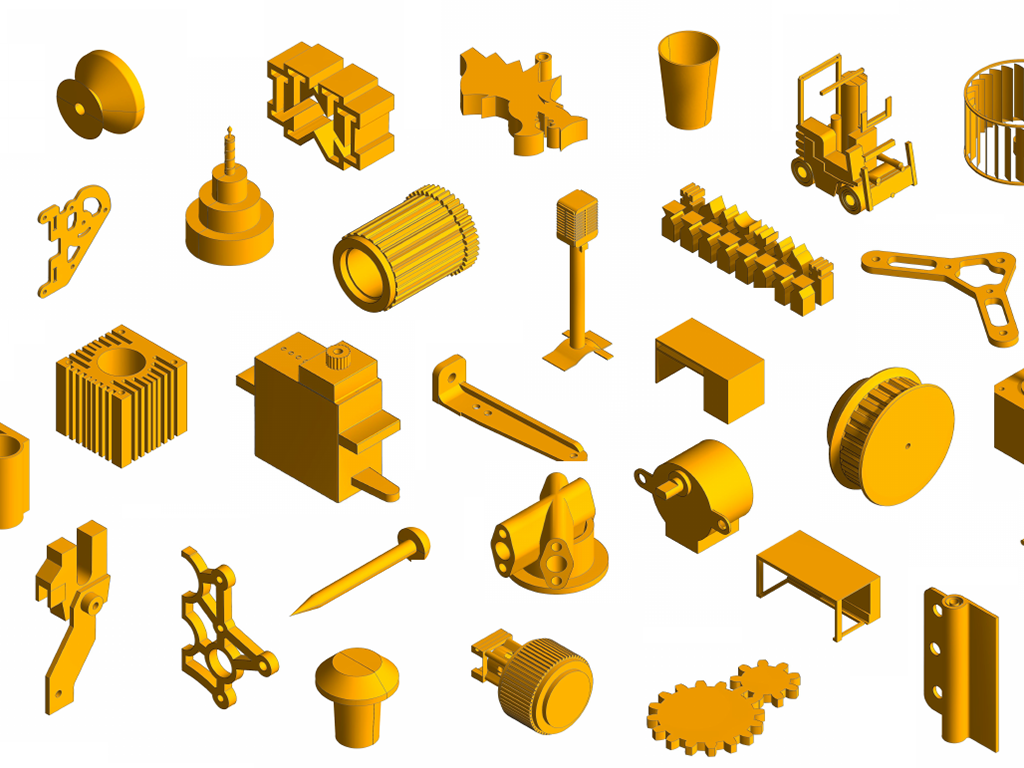
“CAD models are the digital blueprints behind nearly every manufactured product, from airplanes and cars to phones, robots, and household objects,” explains Ghadi Nehme, a PhD candidate in the DeCoDE Lab. Scans and AI-generated meshes may capture a part’s shape, but they lack the editable parameters and construction history engineers need in order to edit them, create variants, or prepare them for manufacturing. Rebuilding them manually in CAD can take hours or even days.
“The broader goal of CADFit is to make product design faster for engineers and accessible to many more people,” says Nehme. “CADFit builds a CAD model the way an engineer would, one operation at a time.”
CADFit uses an AI-guided optimization method to reconstruct this geometry as an editable, parametric CAD model. Instead of producing only the final shape, it recovers a sequence of design operations, including sketches, extrusions, revolutions, fillets, chamfers, unions, and cuts. "It iteratively extracts sketches, uses a learned prior to guide the search, validates solid candidates through a CAD kernel, and fits residual geometry," Nehme says. CADFit achieves state-of-the-art performance on both image and mesh to CAD tasks.
Nehme, Eamon Whalen, a senior research manager at Siemens, and Faez Ahmed, Associate Professor of Mechanical Engineering, who holds the Esther and Harold E. Edgerton Career Development Professorship, are the authors of a new paper on the work that was presented at the International Conference on Machine Learning (ICML) 2026 in Seoul in July.
"One of CADFit’s strengths is that it does not depend on large proprietary training datasets or sending a company’s designs to the cloud,” says Ahmed. “The optimization runs directly on the geometry, which makes the approach especially attractive for engineering companies where data, precision, and design confidentiality matter."
According to the researchers, potential applications include reverse engineering scans of physical or legacy parts into editable CAD; turning supplier-provided STL files into models engineers can modify; accelerating the creation of product variants and customized designs; combining CADFit with image-to-3D models to turn a single image into editable CAD; and making AI-generated 3D content usable in real product-design and manufacturing workflows.
The team also developed CADStudio, an open-source interface that lets users import CADFit’s generated code and continue editing it through a familiar feature tree. Together, the system connects AI-generated geometry with human engineering workflows, helping engineers work more efficiently while opening product design to a broader group of users.
The paper, "CADFit: Precise Mesh-to-CAD Program Generation with Hybrid Optimization," is available on arXiv. Code is at github.com/ghadinehme/CADFit, with additional results on the project page.