Inventor Creates Hub for Innovation
As the holder of 12 patents for inventions ranging from a Nerf ball blaster to a biopsy needle, Bill Fienup ’03, SM ’05, knows it takes more than a great idea to build a successful product. That’s why he cofounded mHub, a Chicago-area business incubator, accelerator, and consulting center that supports entrepreneurs with big ideas but little access to product development and manufacturing services.
“We started the nonprofit to create an environment where entrepreneurs have all the tools, the resources, the equipment, the mentorship, and access to manufacturers, education, and programming,” he says. The goal is to lower the barriers to entry for physical product development—particularly large- and longer-scale projects (a category known as “hard tech”). “We’re making it easy to innovate,” he says.
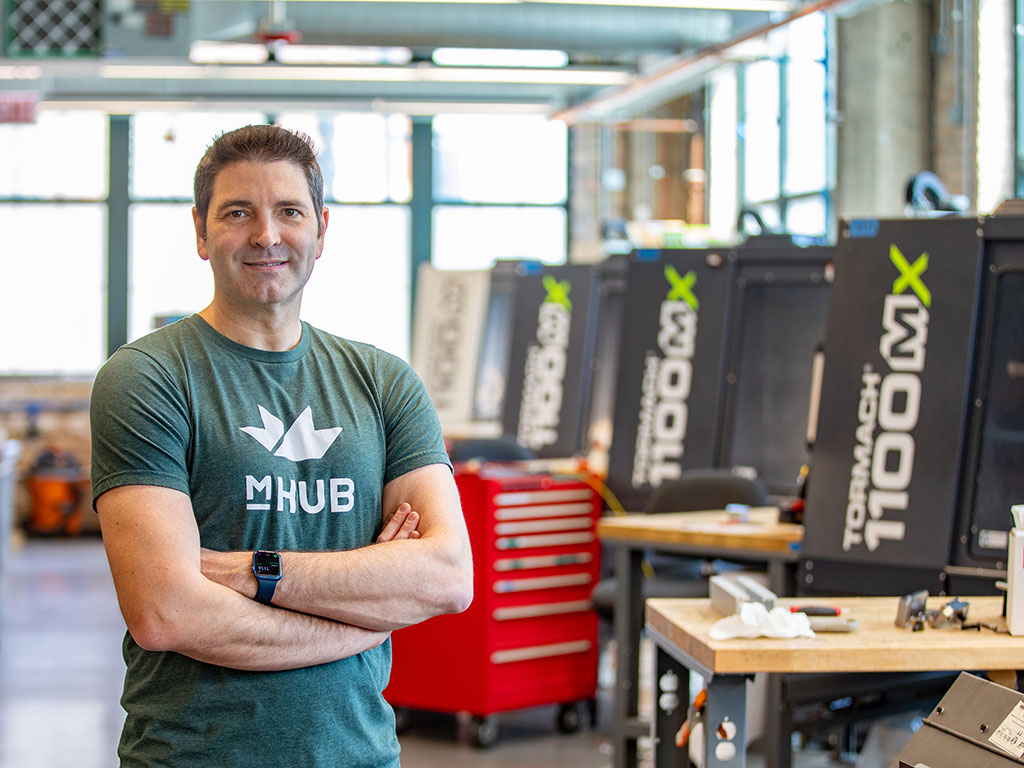 Co-foundef of mHub Bill Fienup ’03, SM ’05. Credit: James Kruml/RoboToaster.
Innovation has been important to Fienup ever since he was a child growing up in St. Louis. He loved to experiment with toys, asking: Can this fly farther? Will this chain reaction turn on a light switch? Why don’t perpetual-motion machines work? He’d find answers and even more questions in long conversations with his father, or in magazines and books where he kept encountering the seemingly all-powerful name MIT.
“That really started my journey of ‘Well, how do I become a part of this?’” he says.
His determination to reach MIT inspired his older sister, Amy Kramer ’98, to attend the Institute herself. When his turn came, he majored in mechanical engineering and zeroed in on product development. The classes 2.007, Design and Manufacturing and 2.009, Product Engineering Processes, outlined everything Fienup wanted to do with his career. “Ninety-nine percent of my direction was based off of those two courses,” he says.
"We’re making an impact for the local economy."
As a graduate student, Fienup got the chance to co-create toys for Hasbro under Professor David Wallace SM ’91, PhD ’95. He also helped Wallace develop 2.00b, Toy Product Design (aka Toy Lab), a project-based class that takes undergraduates from sketching to prototyping toys.
Later, Fienup worked at the consulting companies Ideo and Insight Product Development, focusing on medical devices, consumer electronics, and some industrial products.
Then he tried his hand at entrepreneurship. He built up and shut down one startup centered on retrofitting home gas furnaces and another based on a device for monitoring restaurant freezer temperatures. Fienup’s experiences as an underresourced, undersupported founder inspired him to create a startup hub he called Catalyze, which grew into mHub when he partnered with the economic development strategist Haven Allen.
“I found myself alone in my apartment, trying to build a physical product without the tools or the people to bounce ideas off of,” he says. Inspired to help others overcome such barriers, he launched mHub.
Through mHub, innovators can access a state-of-the-art prototyping lab, tap into networks of industry mentors, find investors, and learn business and technical skills. One startup used mHub’s high-powered 3D printers to prototype a wearable patch that aids in diagnosing gynecologic cancers, for example. Another set up a manufacturing line at mHub to create haptic hardware for use in virtual reality and robot teleoperation.
Since mHub launched in 2017, affiliated companies have raised around $2 billion in capital, launched a total of 1,700 products, and employed about 7,000 people in the Chicago area. Once a business’s manufacturing needs outgrow mHub’s capabilities, reps connect its owners with bigger manufacturers—about 75% of which are based in the United States.
“We’re making an impact for the local economy,” Fienup says.
While he serves mHub as vice president of innovation services, he’s also raising three small children—and still finds time to innovate. He currently spends his rare free time working on CanChill, a portable device that can chill a canned drink in three minutes. Fienup says such projects keep his mind sharp and his finger on the pulse of creation.
“To be an active mentor, I have to continually understand the pain points that entrepreneurs are experiencing,” he says.