The MechE Innovation Landscape
Hundreds of companies founded by MechE alumni are active in biotech, AI, energy, robotics, and many other fields
According to research conducted by MechE graduate student Jadal Williams last summer, well over 300 companies have been founded by MechE alumni since 2010. Geographically, the companies he identified span the more than a dozen U.S. states and several other countries around the world and, in many cases, they were a direct result of research the founders carried out as part of their MIT studies.
MechE-born companies have produced innovations that have had a significant impact on a wide variety of fields, with the largest concentrations of recent companies in three sectors: artificial intelligence and machine learning, biotechnology, and energy.
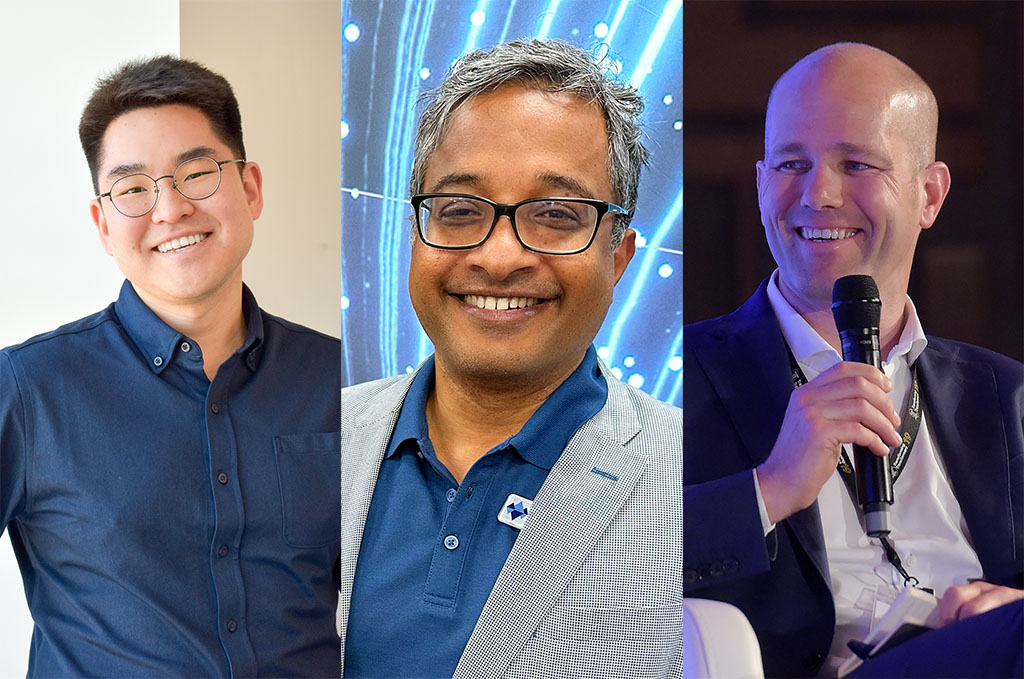
Hyunwoo Yuk, founder and CTO of SanaHeal, a company developing adhesive materials that have the potential to revolutionize the treatment of traumatic injuries and the control of bleeding during surgery, says the company “spun out of MIT mechanical engineering research I did during my Masters and PhD program,” where he and collaborators developed “a class of biomaterials that can stick to wet and bloody surfaces.”
It all started, Yuk says, with “the research work and publications we wrote as a team in mechanical engineering, myself and my PhD advisor Xuanhe Zhao, and we had a large group of postdocs and grad students that I closely worked with.” When the research showed promise as a commercial venture, he says, the department and the media teams at MIT “have been very good at popularizing our research over many years.”
The company’s first product, soon to be released, will be for care of trauma bleeding, because this indication may not require clinical trials to secure FDA clearance. “Obviously, when you have a technology that can literally seal off a wet and bleeding tissue, this is the most immediate and dramatic application -- you can think of it as like duct-taping leaking blood vessels instead of leaking pipes in your basement.” The product is expected to be used by the military for emergency care in the field, and for emergency care by EMTs or in trauma centers in hospitals. The next products in the pipeline, Yuk says, will be to control bleeding in surgery, using material that will be degradable and resorbable in the body, as well as surgical meshes and adhesives for nerve repair. The company concentrates on research and development, partnering for the manufacturing and distribution to established companies.
The potential applications, he says, go beyond anything he or their team ever imagined. “It turns out that sticking something is such a universal activity, in a way, that you can find many applications.” As a result, the company is working on so many different variations of the material that, "It's a hard company to run,” he says, “but it’s a good problem to have. If a startup has too much work to do, I think it’s a good thing.”
While many alumni-founded companies grow directly out of research carried out during MIT studies, others begin much later, many years after graduation, yet draw significantly on the skills, innovative spirit, and personal connections forged during those years. Suryaprakash Ganti, co-founder and CTO of Frore Systems, received his mechanical engineering PhD from MIT in 1997, and then spent years working at GE and then at Qualcomm, before starting the new company in 2018.
After his experience at Qualcomm, he and his partner Seshu Madhavapeddy decided to figure out “what is the next big problem we need to tackle.” They decided to look for new solutions to the problems of “thermal throttling” of chips, where cellphone chips that could operate at 5G speeds often had to be throttled back to 4G operation to prevent damaging overheating. To address that, and the problems of cooling microchips in general, the company has developed highly innovative cooling technology that can be used for the chips used in computers and data centers.
They formed the company with a clear concept in mind but had not yet developed a detailed solution. “We wanted to develop a fundamentally new approach to this problem,” he says. “It took us about six months with a very strong team. We hired very bright people both from MIT as well as from Stanford, people that helped us develop our core idea into an engineering design.”
The solutions they developed, unlike traditional chip cooling technology based on mechanical fans, use variants of the technologies used to manufacture silicon chips, and so can be rapidly adapted to mass manufacturing methods. They realized silicon itself was not suitable for their purpose, but similar manufacturing processes could be adapted to work with other materials. “We developed a completely new technology in terms of manufacturing using metal etching and using metal-based structures.”
They use wafers of metal precisely etched with complex patterns of channels that drive air through at extremely high velocity, producing jets of air strong enough to eliminate the issue of boundary layers of air that form a kind of blanket over the surface being cooled and thus reduce the heat transfer efficiency. With no real moving parts except ultrasonic vibrating structures inside, the new devices are virtually silent in operation.
Because they are using technologies based on silicon chip manufacturing, Ganti says they expect to be able to keep improving performance steadily in a way similar to the “Moore’s Law” exponential improvement over time. Already, their cooling systems have enabled the design of a computer about the size of a coffee cup saucer, one-fifth as thick as a Mac Mini but with better performance, he says.
The latest version of their technology, to be introduced next year, addresses the more intense cooling needs of data centers, and can cut in half the amount of water needed for chip cooling in these centers while also reducing the energy needed, potentially helping to solve major issues facing the proliferation of these centers.
Recalling his MIT experience, working under professors David Parks and Frank McClintock, Ganti says “the mentorship and advice they gave me was excellent, in terms of how they taught me completely to reimagine the material science part of it as well as mechanical designs.”
When he worked at GE on a wide range of different consumer and industrial projects, he says, he had “ the confidence that was primarily because of the ability that MIT has taught us actually to be able to attack all these hard problems that others can't go after… MIT gave us a broad education, not only in mechanics and materials, but also in manufacturing and control systems. So that gives you the depth and breadth that is needed to be able to go after these problems.”
Many companies founded by alumni of the department have involved a fusion of mechanical engineering and computer science, making use of rapidly developing artificial intelligence and machine learning processes. For example, Akselos applies advanced computational techniques to the design and operation of massive energy-related engineering projects, including oil and gas facilities and offshore wind turbines.
Thomas Leurent SM ’01, co-founder and CEO of Akselos, says the idea for the company took shape nearly a decade after he earned his degree, after having worked in various industries in between. Returning to MIT, he was introduced to Phuong Huynh, who was a postdoc at MIT at the time, and research scientist David Knezevic, who Leurent describes as “a born entrepreneur.” They came up with the idea for applying advanced computation techniques to the finite element analysis that are standard in large engineering systems, to find ways to safely manage some of the world’s most critical infrastructure, while maximizing its performance and lifespan. They quickly decided to pursue it, going to MIT’s Venture Mentoring Service for help.
The VMS staff expected that Leurent and colleagues might have spent many months already working to develop their plans. But Leurent had worked with VMS before and knew people there well, and said “’We just met last week, but this is big, we should try it.’ And so they assigned us five fantastic mentors, who between them had worked with a half-dozen companies on the NASDAQ. A really great team.”
They initially spent five years developing the company in stealth mode, with help also from MIT’s Industrial Liaison Program, through which they eventually met with a team from Shell that was looking for technologies that could drastically lower the capital expenses needed for future large-scale energy projects. “And they came across what we were doing, which is a super-high-speed simulation of mechanical engineering, and they’re like, okay, that should be one of those.”
The company signed a contract with Shell in 2015, which they drew up at their kitchen table, to work on the development of a new floating production and storage operation (FPSO), a massive project that he describes as being “like you take the Empire State Building and put it horizontally in the water, in kind of unfriendly water.” These projects “are just massively complicated to simulate, if you want all the details.” The project went well, and Shell invested in the company in 2018.
That’s the kind of partnership they’ve focused on, he said. Rather than looking for hundreds of customers, they wanted maybe a couple of dozen, “but the partnerships might be companies that make hundreds of billions of dollars of turnover per year.”
That partnership helped Shell win a Global Lighthouse Network award, for sites that are at the frontier of usage of revolutionary industrial technologies. Meanwhile, Akselos continued to expand their portfolio, moving on from oil and gas production and handling facilities, including offshore oil platforms, and on to offshore wind facilities as well. Using their simulation methods, he says, “we can cut the amount of steel by 25 percent in the foundation of floating wind facilities,” he says. They have since expanded to simulating chemical facilities, such as those that produce agricultural chemicals, as well. The company has a global presence, with facilities in Boston, Switzerland, and Vietnam.
Leurent says that “the MIT ecosystem for ventures is absolutely extraordinary, so you just have to tap into this again and again.” He and his team drew great inspiration from the book “Inside Real Innovation,” written by MIT professors, that stresses the importance of spending time in an iterative process, cycling between technology, markets, and products. “Each iteration impacts the others, and so on,” he says, “until you find the right fit.”
As SanaHeal CTO Yuk puts it, “it’s fun to write papers in fancy journals, but at the end of the day, I think for mechanical engineering as a discipline, the spirit is really in the associated impact, through productization. I think it’s basically the core spirit of the discipline… I still believe that mechanical engineering’s very root and the core is industrial impact.”
Yuk adds, “I feel like I had great fun in my academic career at MIT, which I believe is half of my kind of identity. And then I feel like I’m finding the other half of my identity when I get out into industry.”
Over the years, many hundreds of MechE graduates have now had the opportunity to make that transition, and in so doing have made a major impact in the world.
Anecdotal evidence suggests that MechE students and faculty are launching companies at an increasing rate, observes MechE Department Head John Hart. Other recent MechE-born startups include Fourth Power, co-founded by Professor Asegun Henry to commercialize large-scale thermal energy storage technology; Spheric Bio, co-founded by Connor Verheyen PhD ‘23 and Professor Ellen Roche to develop a 3D heart implant to help prevent strokes; and Fabri, co-founded and led by Steven Davis ‘24, which is building data-driven, automated metal casting foundries to support the U.S. industrial base.
And while many MechE alumni-founded companies are based in the Boston area, Silicon Valley is also a hotbed of activity, from hardware to software, including the headquarters of Rivian, founded by RJ Scaringe SM ‘07 PhD ’09; Genspark, co-founded by Wen Sang, PhD ’13; Rox, co-founded by Ishan Mukherjee MEng ’11; and Matter, co-founded by Adi Ranjan MEng ‘14 and Adi Prasad MEng ’15.