MIT Portugal Program presents Marine Robotics Summer School
Fifth annual program invites students from MIT and Portuguese universities to “dive deep” into robotics and ocean exploration
The MIT Portugal Program’s Marine Robotics Summer School provides a broad perspective on current research in marine robotics via lectures with MIT and Portuguese faculty and other renowned experts in the field, along with workshops, time on the water, general ocean sciences talks and labs, and social activities.
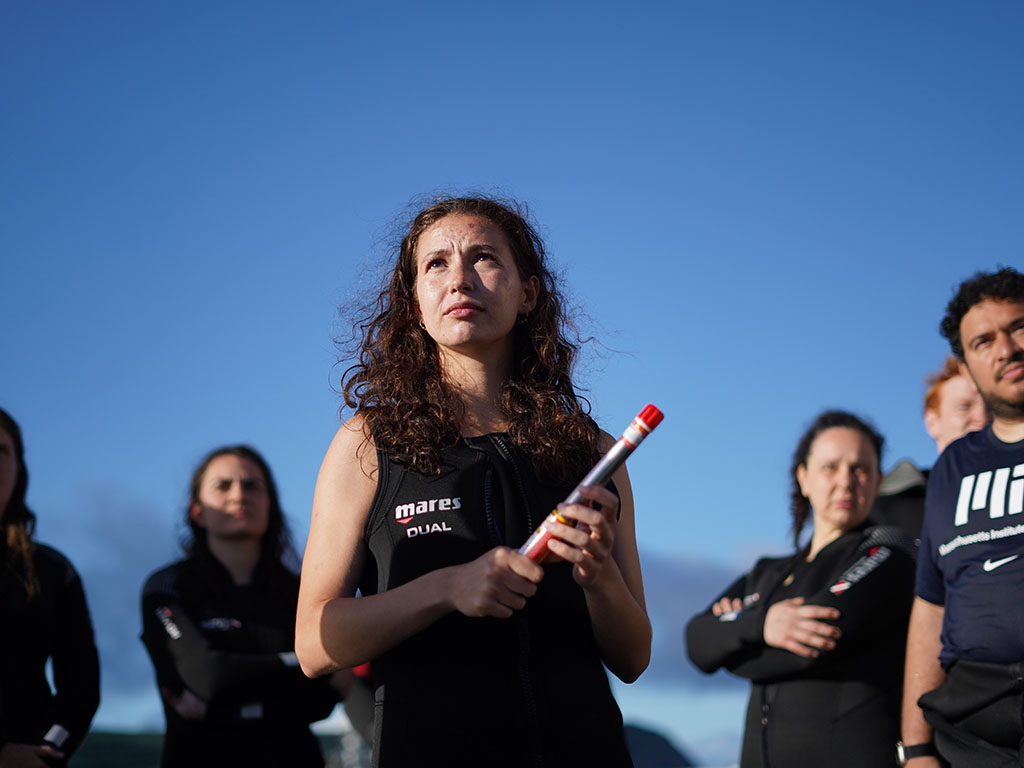
Students participating in the program are fortunate to work in a stunning natural environment where science and technology met the ocean, engaging in theoretical sessions, fieldwork, and hands-on challenges. Each has the chance to work with AUVs (Autonomous underwater vehicle) and ASVs (Autonomous Surface Vehicle), and to build their own ROV (Remotely operated vehicle). Using the ROVs, students collect data — including images, acoustic signals, salinity, temperature, and more – and dive into the deep sea of the Azores to explore its rich biodiversity, including elasmobranchs and cetaceans.
Marianna Rogers, a graduate student in mechanical engineering at MIT, says it was “fun and exciting” to have the chance to do real field work and to use an ROV. “We use sonar to map the depth and the surface of the seabed and then also use the camera in our ROV at depth to track fish,” she says. “So, you're actually seeing the science and engineering play with the ocean.”
For some students, the experience introduced completely new worlds. “I come from a mechanical design background and know nothing about the ocean or marine life or even like what an AUV was,” says Henry Smith, an MIT undergraduate in mechanical engineering.
This exposure, says Douglas Hart, professor of mechanical engineering at MIT, is important. “Students need to be exposed to many different things to really appreciate things,” says Hart. “Regardless of whether we're successful at making them passionate about the ocean, I think we've at least educated them so they appreciate the importance of the ocean and the future of the oceans.”
The 5th annual Marine Robotics Summer School took place July 7-18 at Faial Island, Azores, Portugal, with more than two dozen students from MIT and Portuguese universities.
The program opened with a series of talks on marine biology, where students learned more about the marine biodiversity of the Azores and about tagging and research techniques developed and used by researchers at the Okeanos - Institute of Marine Sciences to better understand the region’s ecosystems. Staff from the Azores School of the Sea also paid a visit, offering a series of theoretical and practical sessions focused on maritime safety.
“For me, the most interesting part was to connect with people from different backgrounds, from engineers to even Navy,” says Margarida Duran, a University of the Azores student. “In order [for] to science to thrive, we need to communicate with each other and understand each other because we have different language to say the same thing.”
Charlene Xia ‘17, SM ‘20, a teaching assistant for the program, worked with students on the underwater remote-control vehicle.
She says the students took the ROV project further than she expected, sometimes working in less than desirable conditions. During rainy conditions, for example, students had to collaborate not just on the tech, but to keep their laptops dry. “The teams’ ROV drivers were crammed inside a Portugal student’s car. But everyone kept working outside in the rain.”
Xia continues, “The main goal of the program to emphasis, especially at an early-stage or their career, the impact and potential of collaboration across disciplines, culture, and boundaries. They were doing things beyond of my knowledge, and that was amazing.”