
Tool Designer Puts “Mind and Hand” to Work
Of all the tools he has designed over the years, Evan Brown ’18 considers his first his favorite: a high-torque impact wrench made for iron workers and truck mechanics that was twice as powerful as anything his company, Milwaukee Tool, had designed before.
Harnessing so much power without breaking the wrench itself took creativity, problem solving, and patience. Still, after many months, 20 prototypes, and a handful of patents, Brown was able to visit several diesel shops across the country and hear from real-life users about how his brainchild improved their day-to-day comfort and productivity.
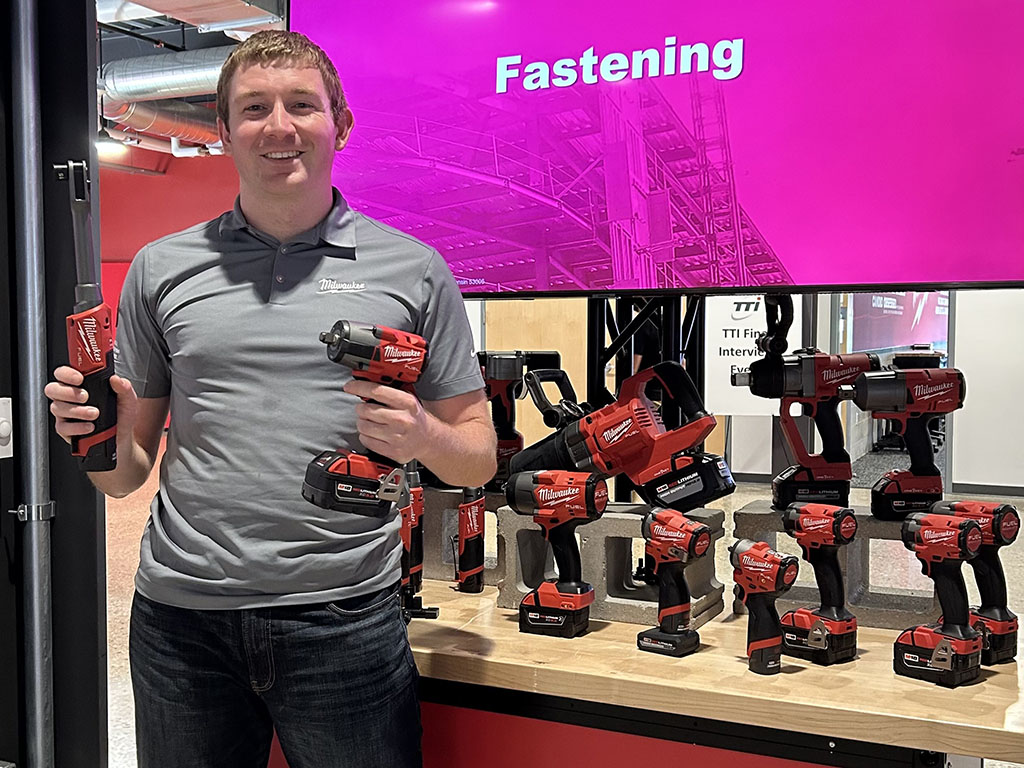
He attributes that achievement to skills learned during his undergraduate studies in mechanical engineering at MIT. Since graduating, his work as manager of design engineering has showed him the true power of MIT’s motto: “mind and hand.” At Milwaukee Tool, Brown now uses both every day, combining imagination and design thinking with prototyping and testing to get new tools onto the shelves of hardware stores around the world.
"You need to have good theory and good calculations—but you also need to build the thing to make sure it actually works."
Brown’s interest in the inner mechanics of things runs in the family. His grandfather owned a small-engine business, selling snowmobiles and lawn and garden equipment. His father was a tinkerer, and Brown adopted the habit, spending hours taking things apart in the family’s garage. A later stint on his high school robotics team cemented a love of projects that allowed him to bring his ideas to life.
That led him to MIT, where he majored in Course 2. There, Brown gained especially valuable experience in manufacturing, machining, and teaching through the Pappalardo Apprentice program, which helps students develop fabrication skills. He also learned a great deal from his senior capstone project in consumer design, which provided practice thinking about the form of his tools as well as their function. “There’s no formula or equation that can tell you what is comfortable; physics doesn’t tell you that,” he says. Taking user experience into account is therefore often a challenge, but it’s one he enjoys.
After graduation, Brown was drawn to Milwaukee Tool in part because of the length of its product-development cycles. He spends between 18 months and two years focusing on a single project, and he and his team own the creation of a tool from start to finish—long enough for a deep dive but short enough to maintain variety. This approach means his days can differ immensely. Some are filled with technical calculations; others with drawing using computer-aided design, running simulations, prototyping, testing, managing project schedules, or eliciting feedback in the field. If the tool is a variation on a familiar design, all these steps might go quickly; “new to world” products like Brown’s first-time impact wrench take more iterating and perfecting.
Even a decade on, Brown still finds himself reaching frequently for knowledge he gained at MIT—such as the importance of designing components that can be easily manufactured. A plastic component with vertical surfaces might look cool, for example, but angled surfaces are easier to release from a mold, saving essential time in an industry with slim profit margins. “You can have the greatest design in the world, but if it costs thousands of dollars to produce, it’s just not viable,” he says.
Plus, designs don’t always behave the same way in the real world as they do on paper, a fact of engineering life that brings Brown frequently back to the “mind and hand” framework. “You really need to do both to be successful,” Brown says. “You need to have good theory and good calculations—but you also need to build the thing to make sure it actually works.”