
Road Safety Drives VP of GM
Growing up in California, Sterling Anderson SM ’09, PhD ’13, loved all technology, especially robotics and cars. But it took a terrible accident to turn that interest into a lifelong mission to make vehicles smarter and safer.
In 2006 Anderson was an undergraduate at Brigham Young University, studying mechanical engineering, when his younger brother was struck by a distracted driver and suffered a severe neck injury. Although his brother eventually recovered, the accident exposed the real risks of the road and motivated Anderson to go into the automotive industry.
“The ingredients were there from an early age,” he says. “But that moment made it painfully clear: We’re not innovating fast enough to keep people safe.”
Earlier this year, Anderson joined General Motors as executive vice president of global product and chief product officer. In that role he oversees the entire product life cycle for both gas- and electric-powered vehicles, including hardware, software, services, and user experience.
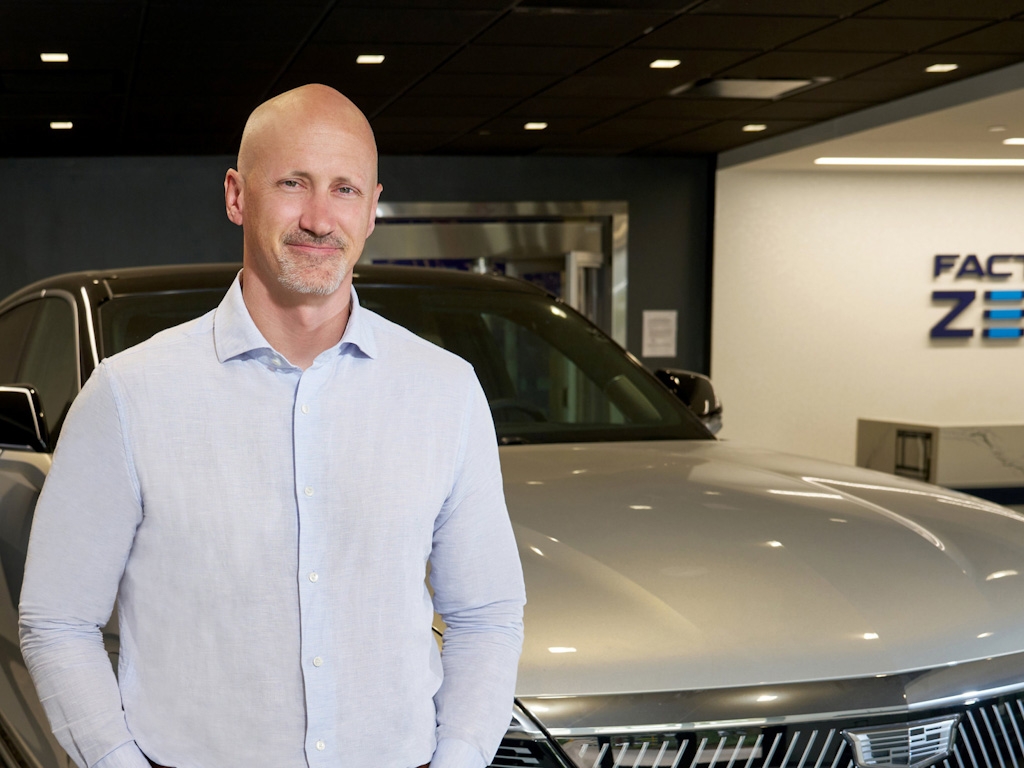
Anderson says he believes GM has a “once-in-a-generation opportunity to innovate on a massive scale” by equipping cars with advanced driver assistance technologies and other new software functionality—potentially preventing future accidents like the one that injured his brother. “At GM, there’s a real drive to make transportation safer,” he says.
Anderson arrived at GM after cofounding Aurora Innovation, where he led the development of autonomous technology designed for important real-world applications—starting with long-haul trucking.
“We founded Aurora to deliver the benefits of self-driving technology safely, quickly, and broadly,” he says. “Trucking was a natural starting point given the sheer size of the market and the massive need for improvements in both the safety and efficiency of the networks that operate them.”
His team created a self-driving truck for long-haul freight that uses an array of sensors and sophisticated algorithms to assess and navigate road conditions. Already operating autonomously on public roads in Texas, Aurora’s trucks will ultimately be capable of hauling goods from Los Angeles to Dallas in 24 hours—a trip that would normally take a human driver nearly three times as long.
“Unlike humans, machines don’t get drunk, drowsy, or distracted,” Anderson says, pointing out that self-driving vehicles can monitor the roadway in all directions simultaneously, even in rain, fog, or snow. They also fill a need: “There’s currently a shortage of 80,000 truck drivers in North America,” he says.
While humans aren’t suited to driving all day and night, they are central to developing these systems. “The goal isn’t to replace human judgment but to build systems that reflect and respond to it,” he says. “Human judgment is a tool we use to guide these technologies toward a deeper understanding of the human experience—how we live our lives, how we share the roadway, and how we define safety and trust.”
Before joining Aurora, Anderson worked at Tesla, where he led the teams that developed the Model X and created Tesla Autopilot, a system that feeds information from sensors into a neural network to enable cars to perceive and react to road conditions.
He says the main point of autonomy is helping people with a tough job. “People underestimate how complex highway driving can be,” he says. “This work is about dramatically improving the safety of our roadways—and the efficiency of our goods networks—and giving people their time back.”
Anderson credits MIT, where he focused on robotics while studying in the Department of Mechanical Engineering, as an incubator that provided him with both the technical foundation and the freedom to rethink how people and machines work together.
“MIT is where I learned to take big, messy problems and actually do something about them,” he says. “Everything I needed was there: incredible people, freedom to explore, and a practical outlet to turn research into real-world impact.”
This story also appears in the November/December issue of MIT Alumni News magazine, published by MIT Technology Review.
Photo: Steve Fecht/GM