The Future of Solid Mechanics
Professor Lallit Anand on why accounting for coupled physics is the future of solid mechanics
Modern technologies increasingly rely on materials that couple mechanics with thermal, electrical, magnetic, and chemical fields. From soft robotics and smart sensors to energy and environmental systems, next-generation technologies demand a deep understanding of materials operating under complex, interacting physical environments.
“The future of solid mechanics lies in coupled physics,” says Lallit Anand, the Warren & Towneley Rohsenow Professor of Mechanical Engineering at MIT. “Coupled mechanics is no longer specialized — it is essential.”
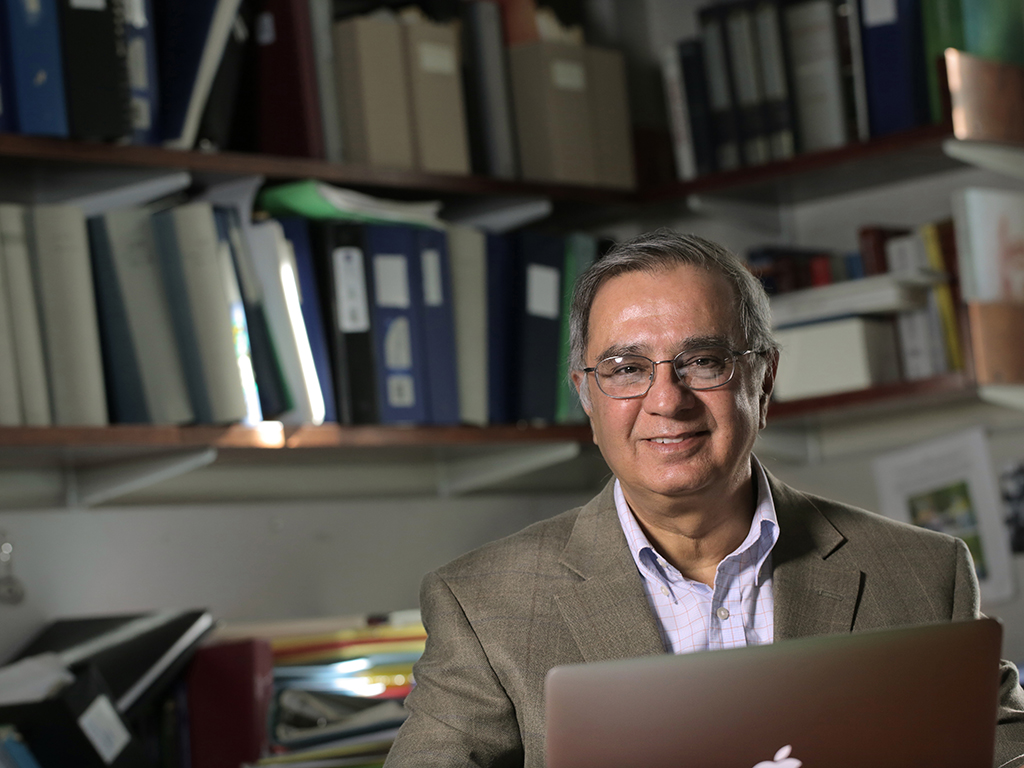 Warren and Towneley Rohsenow Professor of Mechanical Engineering Lallit Anand. Photo: John Freidah
Anand’s research interests include the mechanics of materials, solid mechanics, and plasticity. His new book, Introduction to Coupled Theories in Solid Mechanics (Anand, Stewart, Chester), presents large-deformation theories of elasticity, viscoelasticity, thermoelasticity, poroelasticity, electro-elasticity, electro-viscoelasticity, and magneto-viscoelasticity, with an emphasis on soft materials. The book also includes FEniCSx implementations and open-source simulation codes.
The book aims to help define an emerging foundation for learning in this area. It develops modern large deformation coupled theories for soft materials while bridging theory and computation.
“Over the past two decades, there have been major advances in coupled theories for large-deformation solid mechanics. However, much of this progress is dispersed across journal articles, making it difficult for students and researchers to develop a systematic and coherent understanding of the field,” Anand explains. “There has been no single, authoritative text that brings these developments together in a unified framework. This gap — and the need to help the next generation of Ph.D. students and researchers come up to speed and carry the subject forward — is what motivated us to write this book.”
Anand has received numerous awards for his contributions to Solid Mechanics. In 2018, he was elected to the National Academy of Engineering, one of the highest professional distinctions awarded to an engineer. He received the Daniel C. Drucker Medal from the American Society of Mechanical Engineers in 2014 for “seminal contributions to the formulation of constitutive theories for the plastic response of a variety of engineering solids, including polycrystalline metals, metallic glasses, glassy polymers, and granular materials.”
In 2018, he was awarded the William Prager Medal from the Society of Engineering Science for “outstanding research contributions to large deformation plasticity theory that are becoming part of the core knowledge of the field and are having a significant impact on its development.” In 2017, he received the J. P. Den Hartog Distinguished Educator Award, the highest award for excellence in teaching in Mechanical Engineering at MIT.