Student Spotlight: Shreya Agarwal and Malia Smith
Graduate students Shreya Agarwal ’24 and Malia Smith ’24 bring 2.009 prototype to market
Reusable water bottles offer a host of benefits, both environmentally and for the user. Regular use can reduce plastic waste and cut the carbon footprint of manufacturing and disposal, save users money compared to buying single-use bottles, encourage healthier hydration habits, and potentially lessen exposure to chemicals that are present in some plastics. Unfortunately, there are hazards, too, mainly that reusable bottles can be a breeding ground for bacteria, biofilms, and mold, which can lead to quality concerns or health issues.
One team of students in the Fall 2023 cohort of 2.009 (Product Engineering Processes) saw the problem and set out to solve it. Now, three team members, Shreya Agarwal ‘24, Malia Smith ‘24, and Valeria Gutierrez ’24 have taken their team’s product, Nami, to market. Nami Cleans Co. is “an on-the-go water bottle cleaning solution.” Agarwal is CEO, Smith is COO, and Gutierrez serves as Head of Product. Agarwal and Smith are both current graduate students in Mechanical Engineering.
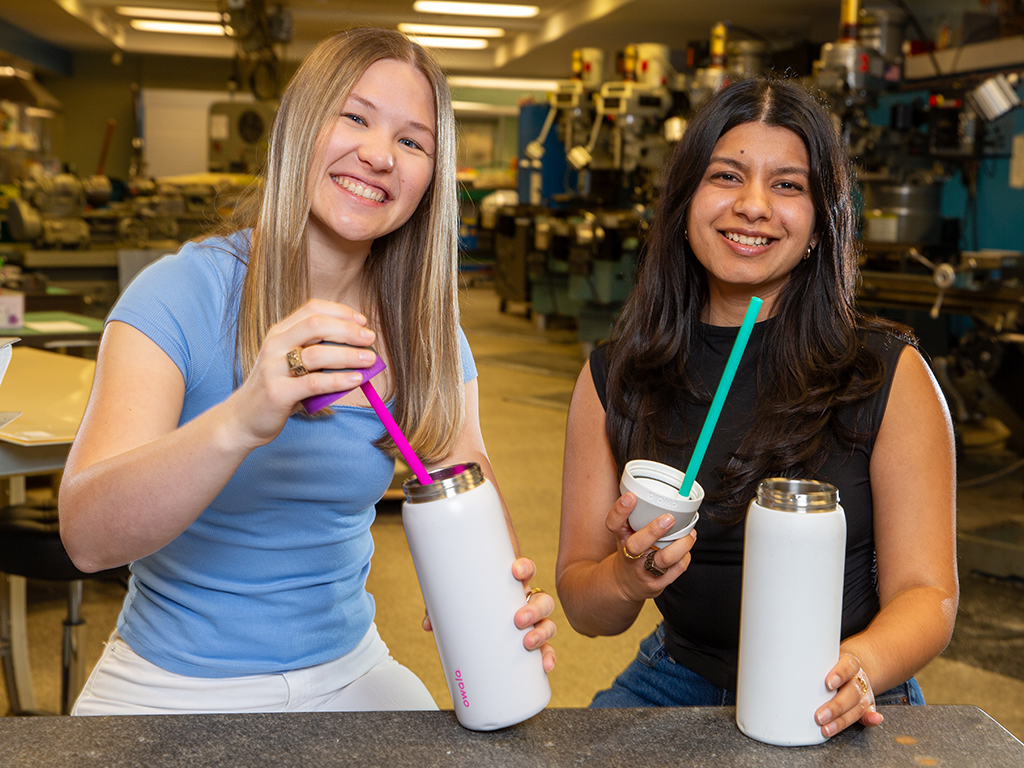
“2.009 had a huge impact on our product and company; it is where we built the first prototype and gave us great proof of concept that the vision can work – and the prototype still works today almost 2 years later,” says Smith. “The experience gave us confidence as we delivered a finished functional prototype in 8 weeks (obviously with the help of the incredible class & Pappalardo staff) and that reminds us that we can do hard things and push the boundaries of what we think is possible.”
2.009 is designed to emulate what engineers might experience as part of a design team at a modern product development firm. Working with mentors, teams of students are challenged to design, build, and draft a business plan for a product prototype. According to Smith, Agarwal came up with the original idea, then the team ran with it after considering their own experiences and realizing there was no easy way to clean their reusable bottles.
“We still have people who saw our 2.009 final presentation and come up to say they remember us and want to see the product out in the real world, which is very validating,” Smith says, but adds that the company’s vision is bigger than the one prototype: it's about solving a clear hygiene problem through a convenient solution.
“We are motivated by being able to solve a real problem for real people… that's really what motivates us every day,” she says. Agarwal adds, “We believe deeply in the problem we are trying to solve, and in the value we can bring to people’s everyday lives.”
Smith, Agarwal and Gutierrez participated in the MIT delta v summer accelerator this past summer, a program run by the Martin Trust Center. Selected teams work on their companies, receive funding, and work mentors and instructors in a rigorous structure designed to advance early-stage ventures. According to recent research, at least eight startups with roots in MechE have participated in delta v.
“For me, one of the biggest shifts during the program was learning how to move between an engineering mindset and an entrepreneurial mindset,” says Agarwal. “As engineers, we are taught to collect all the information first and then act, making sure we have answers before we talk to anyone. Delta v forced us to do the opposite. We had to talk to customers and users before we were ready, communicate clearly even when things felt unfinished, and listen carefully to shape direction. That process guided our thinking around go to market, pricing, business model, and more.”
The delta v model includes regular meetings with a mock board of directors. The Nami team worked with a hand-picked board of individuals with deep experience in hardware, consumer products, and entrepreneurship. Agarwal said the experience taught them how to handle a room of experts, synthesize opinions, take criticism, and defend their decisions. She says the feedback was direct and invaluable, and it pushed them to operate at a higher level.
“Seeing alumni founders who were once in our exact shoes now running successful companies made me believe this is something we can actually execute,” she says. “It made the entire path feel real and achievable. At the end of the summer, I walked away with a lot more conviction in what we are building and that we are the right team to do it.”
The team has also received mentorship and support from the MIT Sandbox Innovation Fund Program and the MIT Venture Mentoring Service.
Smith is pursuing a master’s in mechanical engineering and works in the MIT Sports Lab, where her research focuses on biomechanics and data analytics. She is also interested in more general sports research, design and manufacturing, and sustainability, and seeks to integrate her enthusiasm for engineering, community impact, and sustainable innovation across her work.
Agarwal is also pursuing a master’s in mechanical engineering, focusing on technologies that make carbon capture more efficient and commercially viable. She is motivated by applying engineering to real-world problems in energy, sustainability, and daily life.
“None of us really intended to become entrepreneurs,” Smith says, “but working on something we are excited about every day and getting to create our own path forward has validated that we are in the right place.”
Nami Cleans, Co., is now designing the next version of the product and is preparing for their first paid installations.