
Global by Design: Creating innovations that scale across borders
To solve major challenges and deliver products of value to consumers in both developed and emerging markets, innovators must think and act globally – new book asserts
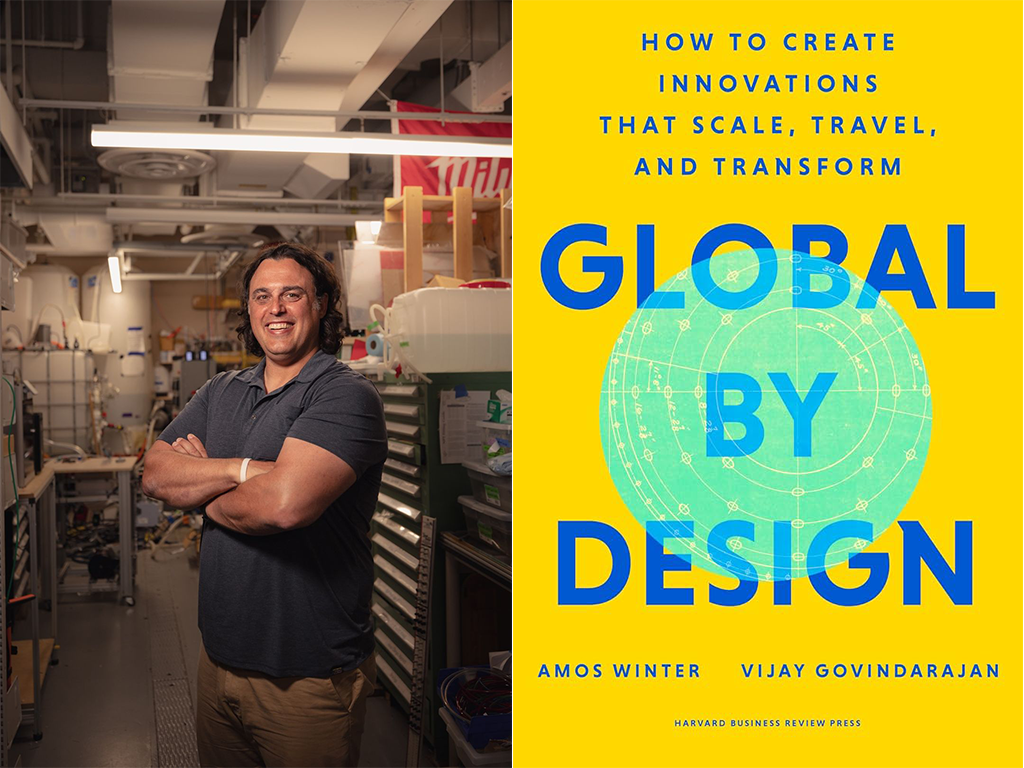
Creating innovations that can succeed in both emerging markets and in developed, higher income markets requires a targeted, thoughtful design process. In a new book Amos Winter, the Germeshausen Professor of Mechanical Engineering at MIT and a pioneer in engineering design, and coauthor Vijay Govindarajan, a leading voice in strategy and innovation, present a framework for creating innovations that scale across borders, industries, and income levels.
“Emerging markets are growing at about twice the rate as the US and Europe. If you're a multinational company that really wants to maximize your growth rate it's not going to be in wealthy markets, it has to be in emerging markets,” Winter says.
He adds that this is particularly true for legacy companies that have successfully sold products in wealthy markets. “You can't just simply take what you sold in the US and Europe and then try to sell it in a place like India, it's probably going to be too expensive [or not meet consumer needs]. We offer guidance on how to leverage what was done before without trying to just copy and paste.”
Global by Design, Winter and Govindarajan’s new book, is presented in three phases and is designed to guide readers though stages of the innovation process, from identifying opportunities to designing solutions to scaling locally and globally. The authors move beyond theory and provide a practical, disciplined approach to spotting problems, leveraging innovation, and building high-value, low-cost solutions with global appeal.
“The book is aimed at how to approach solving problems that are historically unsolved,” explains Winter. “It talks about how to look at those problems with fresh eyes, how to really distill what are the unique requirements that must be satisfied, which often differ from the requirements in wealthy countries, and figure out how to create not just low-cost solutions but really high-value solutions.”
One class of problems Winter points out are issues in the developing world, where people face needs for water, healthcare and energy. “Even though we have solutions to these problems in wealthy countries, they just haven't mapped over, often because the solutions are too expensive or they're not robust enough, leading these problems to persist for generations unsolved.”
Beyond emerging markets, globally minded solutions can also resonate with more resource-constrained consumers and create up-sell opportunities for wealthy consumers. The book also gives guidance about how to not cannibalize existing efforts with product differentiation in different segments.
The authors use five case studies from Winter’s research group, along with industry examples. One case study discusses a product going into production that may reshape agricultural practices in major markets and varying climates throughout the world.
“We created new drip irrigation emitter technology that cuts pumping power in half, reduces the price of solar-powered irrigation by about 40 percent, requires less than half the plastic to make, and is an industry leader in clog prevention,” Winter explains.
The emitters will enable the growth of water-saving, renewable-powered irrigation in low-resource, water-stressed markets and offer a valuable alternative to farmers in wealthy countries. The technology is currently being commercialized by Toro and is expected to go on sale in early 2027. “It is truly a global product that is a better mousetrap, as it meets or exceeds the performance of any other product on the market in every category,” he says.
The research behind the drip emitter technology was recently presented in separate journal articles in Nature Communications and Water.
Winter is also director of the K. Lisa Yang Global Engineering and Research (GEAR) Center, where research focuses on solving technical challenges in low-resource communities. Some of his team’s other notable solutions have been in water purification, agricultural equipment, and assistive technology.
He says he hopes his book broadens design thinking and provides toolsets for innovators to solve meaningful, multifaceted, global problems. “We want readers to walk away from Global by Design inspired to create solutions that are financially viable and create positive social impact. Furthermore, we want them to feel empowered, seeing how they can apply their unique experience, perspectives, knowledge, and resources to make meaningful change in the world.”
Global by Design: How to Create Innovations That Scale, Travel, and Transform is available August 11 from Harvard Business Review Press.