MIT class project turns into an FDA-cleared treatment for tremors
Wristband device from Encora Therapeutics started as a project in 2.009, MIT’s iconic product-design class.
In 2017, a man named Michael walked onto stage in front of a packed Kresge Auditorium at MIT and attempted to draw a spiral, a common test doctors use to diagnose Parkinson’s disease. His tremors, caused by the disease, made the exercise difficult.
Then, Michael put on a wristband device made by a team of MIT students as part of 2.009 (Product Engineering Processes), who were presenting their prototype that evening.
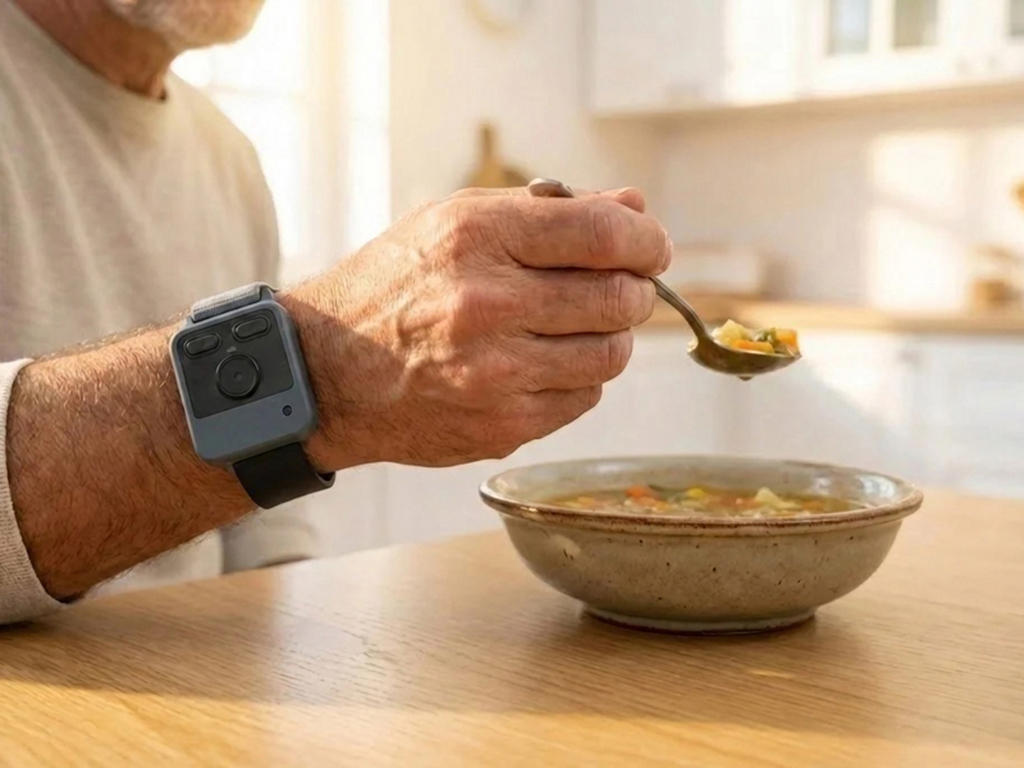
Michael pressed a button and the device produced a subtle vibration. The vibration sent signals up his wrist and into his brain. His tremors dramatically decreased, and within seconds he was able to draw the spiral with much more precision, to a roaring ovation from the audience.
“When this device is turned on, I feel like I used to feel when I didn’t have Parkinson’s disease,” Michael told the crowd. “It’s an amazing, amazing feeling.”
The performance was so impressive that the student team received requests from classmates and others asking where they could buy the device for family and friends living with tremors. Unfortunately, the students had to explain there was only one — for the time being.
The event set off a near decade-long journey that began by leveraging MIT entrepreneurial resources like MIT Sandbox, MIT FUSE, and the MIT Venture Mentoring Service. In 2020, the student team turned into an official company, Encora Therapeutics. But there were still dozens of hardware iterations ahead. Then there were clinical trials. In one trial, 78 percent of patients reported benefits after 90 days of home use.
This February, nine years after Michael’s brave demonstration, all that work finally paid off: The FDA cleared Encora’s device to help adults with essential tremor, a condition similar to Parkinson’s that causes shaking, often in the hands.
“It’s been a long and difficult — very difficult — journey, but also very rewarding, especially when we get feedback from patients,” says Daniel Carballo ’18, SM ’20, an Encora co-founder and vice president of strategy. “We hear stories from patients about how they’ve struggled with their condition and how much they benefit from this. It reminds us why we keep going.”
From classroom to commercialization
The three founders of Encora who are still with the company are Carballo, Allison Davanzo ’18, and Kyle Pina ’18. They were each seniors in 2017 when they enrolled in 2.009, MIT’s popular product-design class.
The semester began with a brainstorming session in which groups of about 17 students were asked to come up with dozens of potential product ideas. Carballo proposed a wearable device that used mechanical vibration to send signals to the brain to reduce tremors. The initial idea was to help patients with Parkinson’s disease.
“It was one of hundreds of throwaway ideas,” Carballo recalls. “The initial concept was inspired by classes I had taken in robotics around neural control of movement. I had a preliminary understanding of how an electromechanical device might interact with the body’s control systems and feedback loops that control movement to relieve pathological control of movement.”
The team eventually whittled their long list of ideas down to a few. Carballo’s idea was finally selected by a vote of 16-1 — with Carballo the only dissenting vote.
“I tried to explain to the team that this was so far-fetched that there was no way, in one semester, we would be able to make anything,” Carballo recalls. “Thankfully, I got outvoted.”
Through most of the semester, Carballo’s pessimism looked justified. At every class milestone, the team lagged behind other teams. Then, the week before final presentations, they met Michael, whose severe hand tremors were the result of early-onset Parkinson’s.
“He was a home renovator, so he worked with his hands, but his tremors had progressed to the point that he struggled to turn a screwdriver, use a drill, or even fill out paperwork,” Carballo recalls. “He had become reliant on his wife and daughter not only to run his business, but to help him with everyday activities.”
By this point, the 2.009 team had a prototype that would vibrate to send mechanical feedback to the brain. Carballo described it as “a foamcore box with a Raspberry Pi chip and some wires coming out.” When Michael put on the device and turned it on, his tremors dramatically decreased.
“It was like a light switch turned on and his tremors stopped,” Carballo says. “His wife and daughter started crying. A week later, he was gracious enough to repeat the process on stage for the final presentations.”
The presentation — and the outpouring of interest from people who wanted it for loved ones with Parkinson’s — made the team determined.
“It showed us there were a lot of people with this problem that could really benefit from this,” Carballo says. “A subset of the team became possessed. It would have been such a shame to know this could exist and to have it never leave the classroom.”
Some team members began using MIT’s entrepreneurial resources to commercialize the technology, initially focusing on Parkinson’s. They ran their first clinical trial with 20 Parkinson’s patients in 2022 in collaboration with MassGeneral Brigham. But they soon learned more patients are living with essential tremor.
“It was a greater unmet need,” Carballo says. “There are a lot of drugs being developed for Parkinson’s disease, but essential tremor hasn’t experienced that same innovation.”
Today scientists think tremor is caused by malfunctioning signals in the regions of the brain responsible for interpreting sensory input and coordinating movement.
“In these diseases, neurotransmitter deficiencies result in this pulsed signaling in the brain that manifests as tremors that are basically pulsed motor outputs,” Carballo says.
One current approach to target those signals is surgery that involves drilling holes in the skull to insert electrodes that drive new electrical patterns in the brain. Encora’s watch-like product targets the same brain regions with mechanical vibrations at the wrist.
“We’re applying mechanical stimulus, basically vibration, to stretch receptors in the wrist, which tell your body where it is in space,” Carballo explains. “The stimulation causes the receptors to activate and send a patterned signal to peripheral nerves of the wrist, that then carry the signal to the peripheral nervous system and into the central nervous system, to the same regions of the brain targeted by surgery.”
In 2024, Encora ran a randomized control trial with 47 patients living with essential tremor. Last year, the team ran a 59-person trial where patients used the devices at home. In both trials, more than 70 percent of patients experienced meaningful improvement.
The results were promising enough to gain what’s known as 510(k) clearance from the FDA for use as a medical device, in February of this year.
Helping patients
Most patients see rapid benefit when using Encora’s device. Patients have described the device as life-changing. Some say it allows them to do tasks they haven’t been able to do in years.
“We see some patients using the device 12, 14 hours a day,” Carballo says.
Today, Encora is focused on building a national sales force and working to secure coverage from insurers. As the company ramps up production, the product will finally become available for patients who qualify.
Further down the line, Encora hopes to fulfill its original mission of helping mitigate tremors in patients with Parkinson’s. Carballo believes the approach also holds promise for many other patients.
“There is a surprisingly long list of diseases that this could work for,” Carballo says. “The most obvious are neurological movement disorders, but the bigger picture of wearable neuromodulation is a rapidly growing field that has seen therapeutic benefit across a broad range of diseases. We see this as a platform technology.”