Jennifer Rumsey
How does a 106-year-old company built on diesel engines evolve to thrive in a decarbonized future? Jennifer Rumsey SM ’98, the chair and CEO at Cummins, is leading the way to answer that question by steering the company toward a future with cleaner power options.
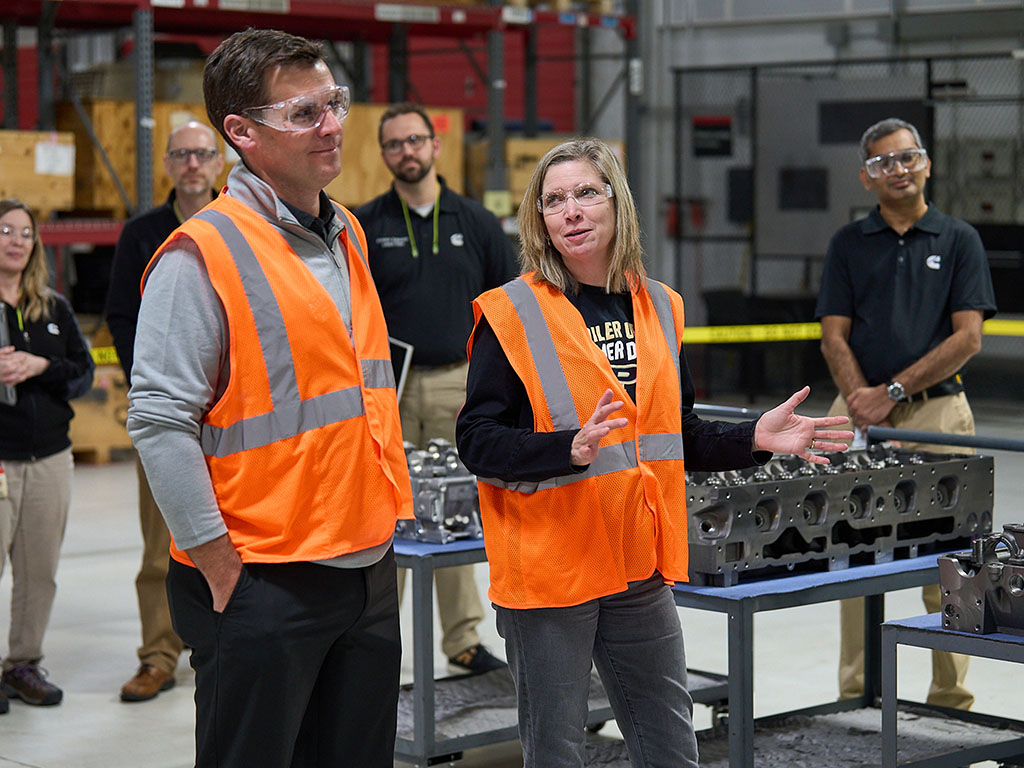 Jennifer Rumsey SM '98, chair and CEO at Cummins, is leading the way to answer: "how a company built on diesel engines evolve to thrive in a decarbonized future?" Credit: Courtesy of Cummins
“Cummins has embraced the need to innovate to reduce the environmental impact of diesel engines,” Rumsey says. “Since 2010, we have improved the miles per gallon of our on-highway heavy duty engines by nearly 25 percent.” Headquartered in Columbus, Indiana, Cummins designs, manufactures, and services a broad range of what are often called power solutions—including diesel, natural gas, electric, and hybrid engines and powertrains, as well as generators and related products—and serves customers in more than 190 countries and territories.
Rumsey, who took the helm at Cummins in 2022, got a head start on her career thanks to a babysitting gig she had as a teenager, working for John Wall ’73, SM ’75, ScD ’78. A vice president at Cummins at the time, Wall recognized Rumsey’s passion for math and science and urged her to consider a career in engineering. “John Wall is the reason I went to MIT,” Rumsey says. “He really encouraged me.”
Although Rumsey completed her undergraduate degree in mechanical engineering at Purdue University, which was closer to home, she came to the Institute for her master’s in mechanical engineering. The experience broadened her worldview. “Being at MIT, you’re just around people from all parts of the country and the world and exposed to leading research and coursework,” she says. For example, one of her classes was taught by the pioneering sound engineer and entrepreneur Amar Gopal Bose ’51, SM ’52, ScD ’56. “That was incredible,” she recalls.
After graduation, Rumsey worked at a Cambridge fuel cell startup for a couple of years but soon grew frustrated by the long lead time to customer adoption for that technology. Seeking more immediate impact, she returned to Indiana to work at Cummins in 2000.
“I understood that we were working on products that power critical commercial and industrial applications, and there was a lot of innovation around reducing the environmental impact of those products,” she says. “That led me back.”
Diesel engines power transportation and industry worldwide, so even small improvements can have a big impact, explains Rumsey, who spent 15 years at Cummins working on these technologies.
The work involved analyzing complex systems like fluid management, heat, combustion, and exhaust cleanup. The goal has been to advance engine technology, leading to a significant reduction in “criteria pollutants” (key air pollutants like nitrogen oxides and particulate matter). “We’ve reduced criteria pollutants from our diesel engines by 98 percent in the US and approximately 90 percent globally,” she says.
"We’ve reduced criteria pollutants from our diesel engines by 98 percent in the US and approximately 90 percent globally."
“We’ve focused on the entire powertrain,” Rumsey says, adding that they aim to improve engine efficiency and integrate the transmission, axles, and brakes into a highly efficient system. Greater efficiency means engines use less fuel, saving customers money and cutting CO2 emissions.
Rumsey began at Cummins as a technical advisor in advanced controls and steadily rose through the organization. In 2015, she became CTO, overseeing research and engineering; she was named president of the components business in 2019 and president and COO of Cummins in 2021. She was instrumental in developing the company’s “Destination Zero” strategy to further reduce the environmental impact of its products, setting clear goals for cutting greenhouse gas emissions.
Fully adapting the $34 billion company for a world less dependent on fossil fuels while continuing to grow will be a tough challenge, Rumsey admits. Fortunately, she has spent most of her life preparing for this challenge—including her time at MIT, where she developed a passion for tackling complex issues and collaborating with teams to find solutions.
This story also appears in the September/October issue of MIT Alumni News magazine, published by MIT Technology Review.