Video-based assessment opens treatment paths for patients with rare disorders that impact movement
Researchers in MechE’s The 77 Lab publish two new papers that employ smart phone use for patient evaluation
Video-based motor assessment could enable important scalable assessment of patients with conditions that impact neurological function, but for patients with rare diseases researchers are constrained by extreme data scarcity and poor generalization that occurs from the study of small cohorts. Two recent papers from the MIT 77 Lab offer smart phone-based frameworks to aid in the assessment of patients with rare neurological disorders.
The first study, conducted with funding from Takeda, is titled “AI-based Digital Assessment of Gross Motor Function in Metachromatic Leukodystrophy” and has been published by IEEE-TNSRE (Transaction of Neural Systems and Rehab Engineering). Metachromatic leukodystrophy (MLD) is a rare, fatal progressive neurodegenerative disorder that causes fatty substances to build up in the brain and nervous system.
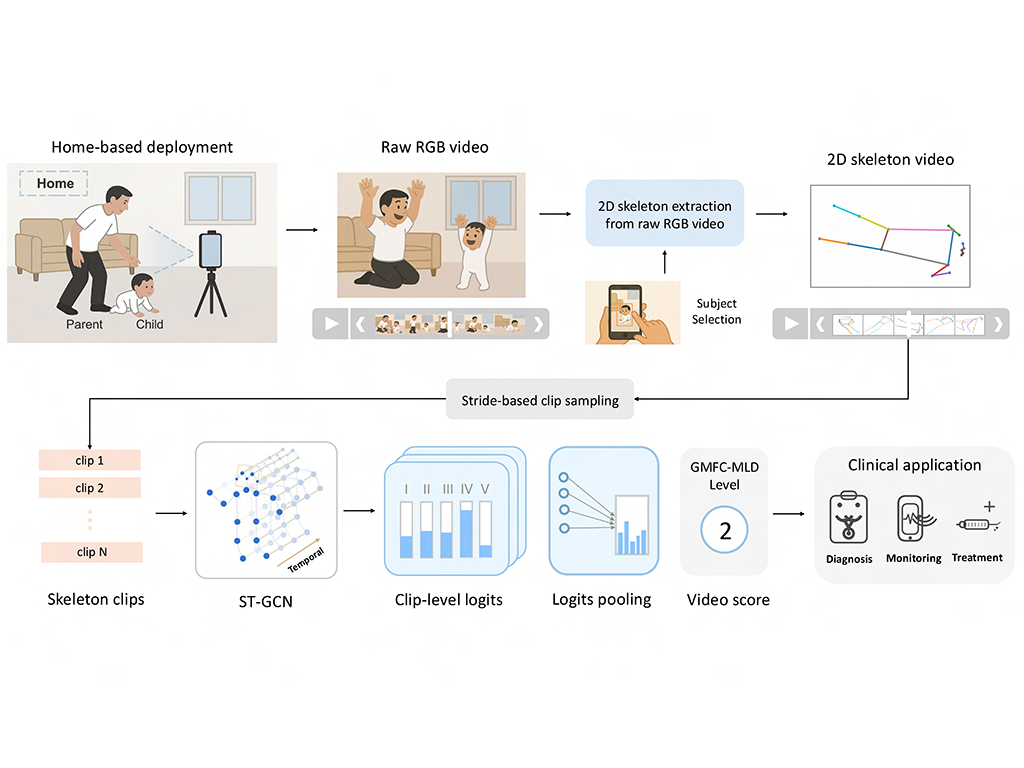 Credit: The MIT 77 Lab, Courtesy of the Researchers
“The goal of the Takeda study was to develop an orphan drug to cure a horrible disease - metachromatic leuko-dystrophy (MLD),” explains Hermano Igo Krebs, principal research scientist in MechE and one of the paper’s authors. “There are not many kids around the world that get the gene defect, [so, because it is rare and there is not enough data], it would be unlikely that we could develop the biomarker directly for this population.”
To overcome the barrier, the team built a 2-step transfer learning approach. They first developed a biomarker for a healthy population drawing from millions of videos of healthy people walking, then used transfer learning to tune the biomarker for assessment of patients with cerebral palsy (CP). Studying patients impacted by CP offered a much larger data set of around 1,600 videos of over 1,000 kids. A second transfer learning effort tuned the biomarker for a very small set of approximately 36 children with MLD.
Krebs heads The 77 Lab, where research combines mechanical engineering and design, computer science and control, and neuroscience and human factors. A second paper, conducted with funding from U.S. Department of War: U.S. Army Medical Research Acquisition Activity, titled “Bridge-Disease Curriculum Transfer Enables Smartphone-Based Balance Assessment in Rare Neurologic Disorders,” explores the use of video assessment for patients diagnosed with NF2-related Schwannomatosis (NF2-SWN), a benign brain tumor that compresses other brain areas as it grows, resulting in gross-motor impacts.
The use of AI offers clinicians or researchers who are treating or studying rare diseases certain advantages. “AI might facilitate early detection, diagnosis, and individualized clinical care,” says Krebs. “For rare diseases, I dare say that there is no better way to accelerate the march of progress.”